What Is Programmatic Advertising? A Plain-English Guide
Programmatic advertising is the automated buying of digital ad space through software, usually a demand-side platform such as DV360. Instead of booking placements by email and insertion orders, you set your audience, budget and bids, and the software buys individual impressions across websites, apps, YouTube, connected TV, audio and digital outdoor screens, often in real-time auctions.

What is programmatic advertising, in simple terms?
Programmatic advertising is the buying and selling of digital ad space through software instead of manual negotiation. The software looks at each available ad slot, decides whether it matches your audience and goal, and buys it at a price you are willing to pay.
Think about how display ads used to be bought. A planner called a publisher, asked for rates, negotiated a package, sent an insertion order and waited for screenshots at the end of the month. Programmatic replaces most of that back-and-forth with rules you set once: who you want to reach, where, how often and at what price.
Say a home loan brand wants salaried people aged 28 to 40 in Pune and Bengaluru who are reading about property. With programmatic, it can show ads to that audience across hundreds of news sites, apps and YouTube videos, cap how often each person sees the ad, and skip impressions that do not fit.
"Programmatic" describes the way you buy, not a type of ad. A banner, a 15-second video, an audio spot or a screen in a metro station can all be bought programmatically.
How is it different from buying ads directly from a publisher?
The main difference is that you buy individual impressions and audiences, not fixed packages. An impression is one ad shown once on one screen.
| Direct (traditional) buying | Programmatic buying | |
|---|---|---|
| How you buy | Negotiate with each publisher and sign an insertion order | Set rules in one platform that buys across many publishers |
| What you pay for | A package of slots, days or a fixed volume | Each impression you choose to buy, usually priced per thousand (CPM) |
| Targeting | Mostly by site section or programme | By audience, context, location, language, device and time |
| Frequency control | Separate for each publisher | One cap across everything you buy |
| Changes mid-campaign | Slow, often needs a new booking | Bids, budgets and targeting can change daily |
| Reporting | Publisher reports, often after the campaign | Live reporting in one place |
CPM stands for cost per mille, the price of 1,000 impressions. It is how most programmatic media is priced.
Direct buying has not gone away. Big sponsorships and some homepage takeovers are still sold this way. But a lot of premium inventory, including OTT apps such as JioHotstar, ZEE5 and SonyLIV, can also be bought through programmatic deals, which gives you those placements with programmatic targeting and reporting.
Who is involved in a programmatic ad buy?
Four kinds of technology sit between your brand and the person who sees the ad.
- Demand-side platform (DSP): the software advertisers and agencies use to buy. DV360, The Trade Desk and Amazon's DSP are well-known examples. Our guide to what a demand-side platform is explains what it does in detail.
- Supply-side platform (SSP): the software publishers use to offer their ad slots to many buyers at once.
- Ad exchange: the marketplace where bids from DSPs meet the supply offered by SSPs. Many SSPs run their own exchange.
- Data and verification partners: audience data, contextual data, brand safety and viewability tools that plug into the DSP.
The publisher, whether a news site, an app, a streaming service or a screen network, owns the space. You, or the agency or partner running your campaign, decide what to buy. If you want to follow a single impression through these systems, read how programmatic advertising works, step by step.
Want to see the numbers for your brand?
Get a free DV360 media plan from our team within one working day.
What are the ways to buy programmatic media?
There are four buying types, and most good plans combine two or three of them.
| Buying type | Who can buy | Price | Delivery promised? |
|---|---|---|---|
| Open auction | Any buyer | Set by auction | No |
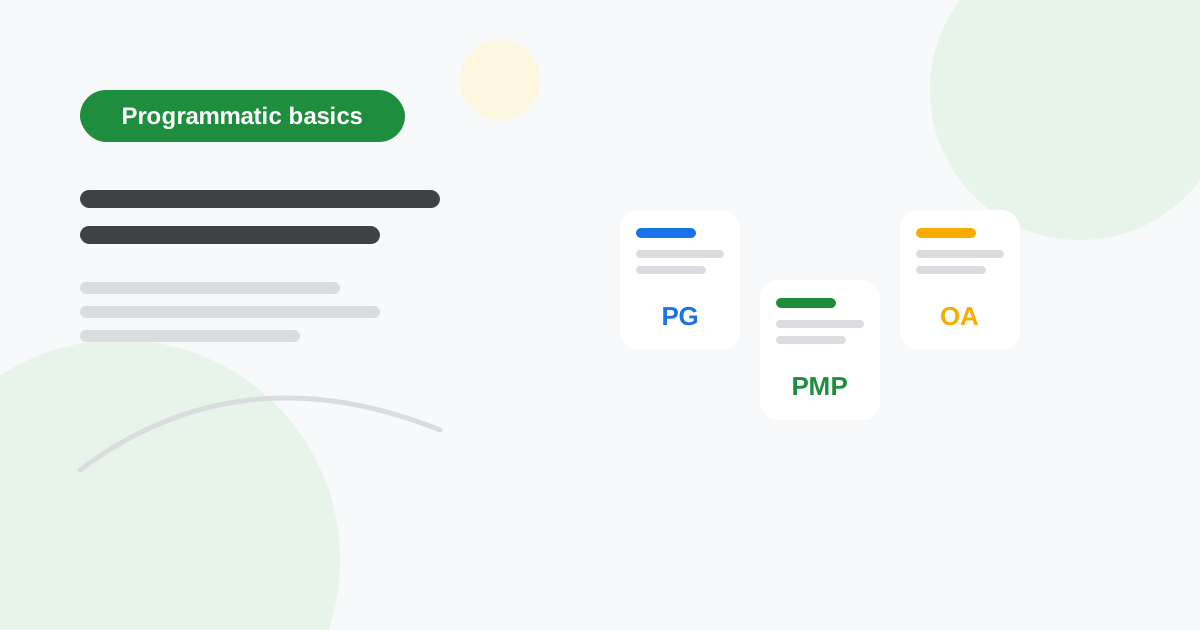
| Private marketplace (PMP) | Invited buyers | Auction above a floor price | No |
| Preferred deal | One buyer | Fixed CPM | No |
| Programmatic Guaranteed (PG) | One buyer | Fixed CPM | Yes |
The open auction runs on real-time bidding, where each impression is auctioned at the moment the page or app loads. It gives the widest reach and the lowest prices, but the least control over where ads appear. PG sits at the other end. You book a fixed volume on a named publisher at a fixed rate, much like a traditional booking, but you run and track it inside the DSP. We compare all four in Programmatic Guaranteed vs PMP vs open auction.
Which channels can you buy programmatically?
Almost every digital channel that carries ads can be bought this way.
- Display and native: banners, rich media and sponsored content units on English, Hindi and regional-language sites and apps.
- Online video: in-stream and out-stream video across websites and apps.
- YouTube: skippable, non-skippable, bumper, in-feed and Shorts ads, bought inside DV360 alongside other inventory.
- OTT and connected TV: ads in streaming apps on phones and smart TVs, from JioHotstar and ZEE5 to Sun NXT and aha.
- Audio: ads in music streaming apps and podcasts, which our guide to programmatic audio advertising covers in detail.
- Digital out-of-home (DOOH): screens at airports, metro stations, malls and highways, priced on estimated audience.
The advantage is that one platform, one set of audiences and one frequency cap can cover all of them. You can see the OTT, news and DOOH inventory we buy through deals on our premium publishers page.
How is programmatic advertising priced?
Most programmatic media is priced on CPM. Video is sometimes bought on CPV (cost per view) or CPCV (cost per completed view). Prices move with demand, targeting and season, so any rate card can only give a range. These are indicative ranges from our own rate card, before GST:
| Inventory | Indicative rate |
|---|---|
| Open auction display | ₹40–120 CPM |
| Rich media on news publishers | ₹90–220 CPM |
| In-stream video on news publishers | ₹120–280 CPM |
| PG and private deals on news publishers | ₹150–450 CPM |
| YouTube bumper ads | ₹100–230 CPM |
| ZEE5 in-stream video through PG | ₹350–650 CPM |
| Metro and mall DOOH screens | ₹250–700 per 1,000 estimated audience impressions |
An illustrative example makes the trade-off clearer. A regional FMCG brand puts ₹10 lakh into open auction display at an average ₹100 CPM. That buys about 1 crore impressions (₹10,00,000 ÷ ₹100 × 1,000). With a frequency cap that averages four ads per person, that is roughly 25 lakh people reached.
Put the same ₹10 lakh into a ZEE5 PG deal at ₹500 CPM and you get about 20 lakh impressions. That is fewer impressions, but in premium streaming content on a known app. Neither is right or wrong. They do different jobs, which is why plans often mix them. For a fuller breakdown, read how much programmatic advertising costs in India.
What are the main benefits?
- Targeting follows the person, not just the site. You can reach your audience wherever they read, watch or listen.
- One frequency cap across many sites. Without it, the same person can see your ad 20 times on one app and never on another.
- Live control. You can move budget from a weak publisher to a strong one within hours, not at the next booking.
- Measurement in one place. Impressions, viewability, clicks, video completions and conversions sit in one report, so comparisons are fair.
- Premium supply in the same plan. Deals put OTT, news and DOOH inventory next to open auction reach.
What are the risks, and how are they managed?
Programmatic reaches thousands of sites and apps, and not all of them deserve your money. These are the risks to manage from day one.
- Brand safety. Your ad can land next to content you would never choose. Use content exclusions, site and app exclusion lists and, for most brands, third-party verification.
- Invalid traffic. Bots and fake apps generate impressions that no person sees. Buy from authorised sellers, which publishers declare in a public file called ads.txt (an IAB Tech Lab standard), and use fraud filtering.
- Low viewability. An impression is counted when the ad is served, not when it is seen. Under the Media Rating Council standard, a display ad counts as viewable when at least half of it is on screen for one continuous second, or two continuous seconds for video. Our guide on how to improve ad viewability covers the fixes.
- Data and privacy. Third-party cookies and mobile ad IDs are less reliable than they were. Safari and Firefox restrict third-party cookies by default, and Apple asks iPhone users before apps can track them. In India, the Digital Personal Data Protection Act, 2023 sets rules on how personal data is collected and used. Contextual targeting and consented first-party data fill much of the gap.
Is programmatic advertising right for your brand?
It suits most brands that spend steadily on digital and want reach beyond search and social. It is especially useful when:
- you want to reach a defined audience across many publishers with one frequency cap;
- you want premium OTT or news inventory with programmatic reporting;
- you run campaigns across several Indian languages and regions;
- you have a clear way to measure results, such as site conversions or a brand lift study.
It is harder to justify on a very small budget. Premium deals usually carry a minimum spend. On our rate card that is about ₹5 lakh for many news publishers and about ₹10 lakh for OTT apps such as ZEE5 and SonyLIV. Open auction campaigns can start smaller.
You also need someone to run it. You can get a self-serve seat if your team has trained traders, share the work with a partner, or hand it over to a managed team. Our comparison of self-serve vs managed DV360 helps you choose. If DV360 is the platform you are considering, our guide to what DV360 is explains how it works.
What mistakes should first-time buyers avoid?
- Judging success by CPM alone. A ₹50 CPM at 20% viewability works out to ₹250 per 1,000 viewable impressions, which is more than a ₹150 CPM placement at 70% viewability (about ₹214). These figures are illustrative, but the maths is the point.
- Running without a frequency cap. A small group ends up seeing the ad dozens of times.
- Skipping brand safety settings because "it is only a test".
- Spreading a small budget across too many channels, so nothing gets enough delivery to learn from.
- Launching before conversion tracking works, which leaves nothing to optimise towards.
Next step
The easiest way to make all this concrete is to see it with your own numbers. Share your goal, audience and budget when you ask for a free media plan, and a DV360 specialist sends a first channel mix with estimated reach and cost. If you want to know how we reach those figures, our post on how a media plan generator works walks through the formulas. Our team is happy to go through the draft with you.